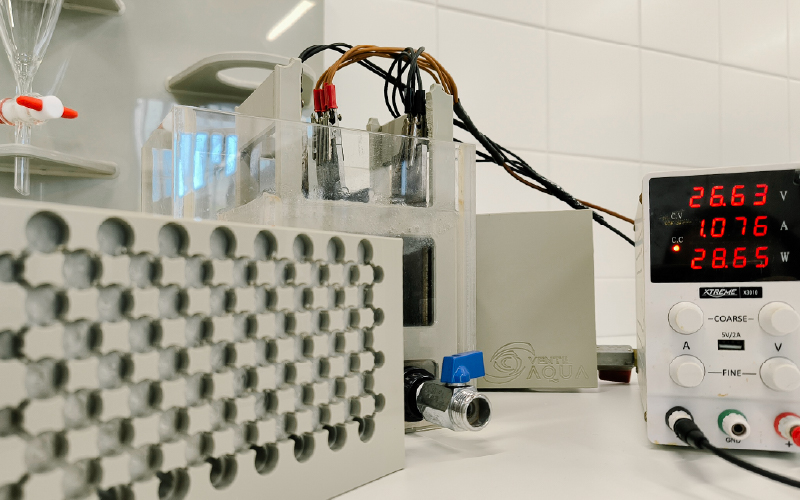
A new technological approach is transforming wastewater treatment plants into resource recovery facilities, combining nutrient recovery with the removal of micropollutants to pave the way for a more sustainable future in the water sector.
Changing environmental and regulatory requirements have presented new challenges to the wastewater treatment sector. The need to reduce the environmental impact of discharges, improve energy efficiency and recover resources from effluents has driven the development of innovative technological solutions. It is against this backdrop that the RENURE project – an integrated and circular process for the recovery of nutrients and removal of micropollutants from wastewater – has emerged, promoted by VentilAQUA and co-funded by COMPETE 2030.
The project proposes the development of an integrated process to treat concentrated liquid streams from wastewater treatment plants (WWTPs), simultaneously promoting nutrient recovery and the removal of micropollutants. The aim is to reduce operational costs, improve the sustainability of treatment systems and support compliance with the new European directive on urban wastewater treatment.
As António Rodrigues, Director of R&D at VentilAQUA, emphasises:
“The RENURE project represents a decisive step in transforming WWTPs into resource recovery units, in line with the principles of the circular economy and the challenges of the new European Directive. By integrating innovative technologies for nutrient recovery and the removal of micropollutants, we are contributing to more efficient, sustainable solutions that are ready for the future of the water sector.”
The challenge of concentrated effluents
Among the various effluents generated at a wastewater treatment plant, the effluents from the digester resulting from the anaerobic digestion process are particularly significant. Although they account for only around 1% of the daily flow, these effluents can contain a significant proportion of the nitrogen, phosphorus and micropollutant load present at the plant.
Due to the high concentrations of pollutants, this effluent cannot be discharged directly into the aquatic environment and is usually recirculated to the WWTP inlet, increasing the energy and operational costs of treatment. RENURE seeks to address this challenge by integrating various advanced technologies that enable these effluent streams to be treated efficiently and sustainably.
Nutrient recovery and resource recovery
One of the project’s main focuses is the recovery of nutrients, particularly nitrogen and phosphorus, present in runoff. The strategy involves converting these into struvite, a mineral that can be used as a slow-release fertiliser.
To this end, the process combines technologies such as electroreduction and crystallisation, using the NETmix static mixer to ensure efficient mixing and promote mineral formation. The system also includes an electrochemical reactor with magnesium electrodes, which supplies the reagent required for struvite formation.
This approach enables the transformation of a problematic effluent stream from WWTPs into a source of value, promoting the circular economy and contributing to more efficient resource management.
Removal of micropollutants and technological validation
In addition to nutrient recovery, the project focuses on the removal of micropollutants through electro-oxidation and ozonation processes. These technologies enable the degradation of persistent compounds and reduce the presence of residual ammonia in the treated effluent.
The project also envisages the development of an innovative electro-ozoniser based on water electrolysis, capable of producing ozone with lower energy consumption and with the potential to simultaneously generate green hydrogen.
Following the laboratory testing phase, the integrated process will be validated on a pilot line installed at a wastewater treatment plant managed by project partners, enabling the performance of the technologies to be assessed under conditions close to those of actual operation.
Funding from COMPETE 2030 and the collaboration between VentilAQUA and the Faculty of Engineering at the University of Porto have been crucial to the project’s progress. As António Rodrigues notes:
“Support from COMPETE 2030 has enabled us to proceed with the development and validation of these solutions in a relevant environment, creating the conditions to test, optimise and bring the technology closer to practical application. The collaboration between VentilAQUA and FEUP has also been crucial in combining scientific knowledge with industrial experience.”
More than just a technological initiative, RENURE aims to contribute to a sustainable transformation in the water sector. As António Rodrigues concludes:
“More than just an R&D project, RENURE is a concrete contribution to the sector’s sustainability and to more efficient resource management.”